
Written by Phoebe
I love moving around with my pals. To me, every journey feels like an exciting adventure, especially when we have to travel south to escape the bitter winter cold up north, where we make our home. Summer is easy and full of life. There is so much to see, so much to eat, and always more than enough to go around for my pals and me. Most of them prefer quieter places—places with fewer moving blocks and endless stretches of grassland, bright yellow canola fields, and horses wandering in the distance. Humans call it the country.
My pals think it’s peaceful. I think it is a little too peaceful.
Now, that’s where I defer to them; I love big busy places. “Cities,” as some of my friends often like to correct me. “Big places” is a pretty straightforward description to me, so I stuck with it.
Now, this is where my pals and I disagree. They love the peace of the country, but I prefer big, busy places.
“Cities,” some of my friends are always quick to correct me.
I still call them “big places.” It is a simple, straightforward name, and it makes perfect sense to me, so I have decided to stick with it.
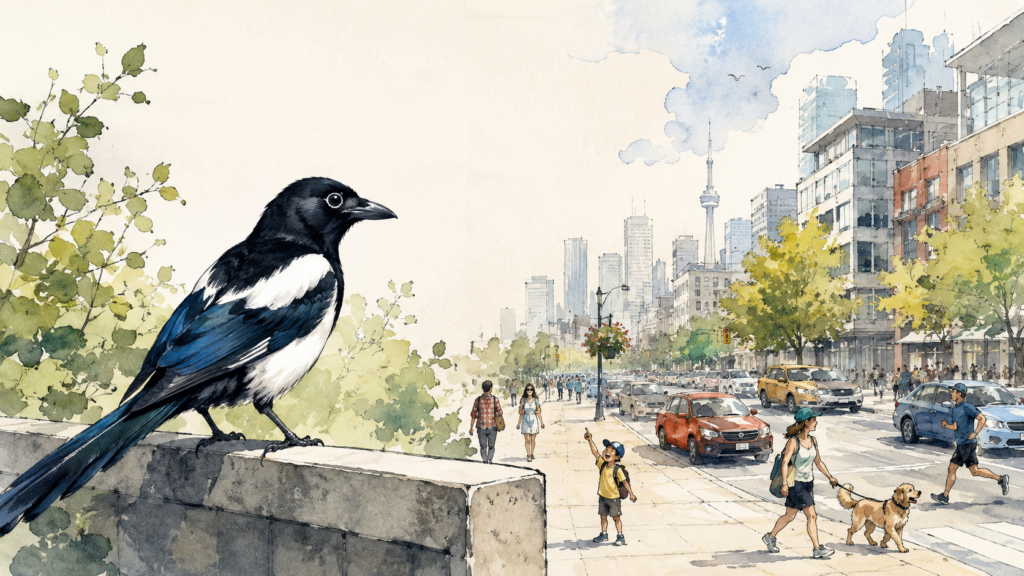
What I love most about these big places, with their square caves, tall trees, and crowds of humans, is that something is always happening. Something is always moving, especially those bright, colourful blocks rushing through the streets.
My usual spot is near a busy place filled with moving, colourful blocks—what humans call cars. They rush past in every direction, honking and flashing in the sunlight. But to me, no matter what humans call them, they will always be very colourful blocks.
Another fascinating thing about the big places is the humans.
Whatever they do with their legs, they call it either “walking” or “running.” I still don’t understand how they manage to balance those long things attached so high up. I tried standing like them once. Both the humans and the other birds laughed at me.
I never tried it again.
Humans come in so many sizes, shapes, and colours. They also seem to carry something in their hands wherever they go. Yet, now and then, I hear one of them say, “Give me a hand.”
Why would they need another hand when they already have two?
The smaller humans who follow the bigger ones around are called kids. I find that rather strange. Does that mean they are baby goats? Perhaps it does. They certainly make enough noise. They are always squealing in high-pitched voices, as though they are competing to see whose voice can fly the highest.
“Mommy! Mommy! Look at the bird!”
Whenever they shouted that, I would look around, wondering what they were talking about.
What was a bird?
Was I a bird?
I questioned almost everything about humans. For example, how could they live without feathers? Some of them collected the feathers I dropped and thanked me as though I had given them a gift.
They never asked my permission in the first place.
I also saw humans willingly walk into the mouths of the largest creatures I had ever seen. At first, I thought these creatures must have been distant relatives of ours. They had wings, but no feathers. Their bodies were smooth, hard, and shiny.
The humans walked straight into their bellies without screaming or trying to escape. Then the giant creatures flew away with them.
Strangely, they sometimes returned and released the humans again. I assumed the humans must have made their stomachs uncomfortable.
Humans also walk and run beside large animals called “DOGS.” DOGS do not speak the way we do, so I never understand what they are trying to say. They seem to have a great interest in squirrels, though.
Cats, on the other hand, hate us.
Some humans try to speak our language whenever they pass by. Of course, most of what they say is complete nonsense.
One day, a man stopped near me and a few of my friends. He lifted his head and made a series of strange sounds, apparently trying to speak to us. The humans around him clapped proudly.
We laughed.
The humans clapped again, believing we had answered him.
Well, we had—just not in the way they thought.
What the man had actually said was:
“I eat brown water.”
Who would say such a thing with pride?
I kept a dictionary in my head filled with the new words I heard every day:
FONE
DAVID
SHEART
HAART
DANSE
They were very interesting words. Eventually, I learned how humans spelled some of them correctly, but I could never pronounce them the way humans did. The only creatures that came close to making those sounds were the others of our kind, whom I heard the humans call “PARROTS.” I suspected dogs and cats figured out the human language but only spoke it to them when the rest of us weren’t watching, so we wouldn’t figure it out and take their places living in human blocks as they did. Nonsense! I would never trade my freedom for their place!
Older humans seemed especially fond of talking. Some of them never stopped. They always had another story, complaint, question, or piece of advice waiting to come out of their mouths.
But others never spoke to anyone.
They walked past with straight faces, staring ahead as though no one else existed—as though no one around them mattered.
That frightened me more than all the talking.
My pals and I never passed one another without saying something, whether we were flying through the air or hopping along the ground. It was simply good manners. A small sound was enough to say, “I see you. You are here. You matter.”
Humans could be strange that way.
Sometimes, they stretched their faces wide, almost like DOGS. I later learned that this was called smiling, but it still looked slightly frightening to me.
By then, I was beginning to suspect that I might actually be a bird.
One afternoon, a long-haired human stopped and stared at me.
“Maybe I should ask ChatGPT what kind of bird he is,” she said.
How did she know I was male?
She pulled a small, flat block from her pocket and began tapping it as she walked beside another human. Apparently, the block was called a “PHONE.”
I still preferred FONE.
Humans seemed to love blocks. They lived in enormous square blocks, carried little blocks in their hands, and travelled inside colourful moving blocks. They were always climbing into them or stepping out of them, even though the moving blocks sometimes crashed into one another with humans still inside.
There were far too many of those colourful blocks.
My friends and I found it amusing to leave little “statements” on them whenever we flew overhead. We did the same for humans whenever the opportunity presented itself.
It was our special way of saying, “We noticed you.”
Or perhaps, “We think your colourful block is beautiful.”
There was always something new to learn about humans. Every day, my dictionary grew, and so did my list:
Humans can run quickly or slowly.
Humans love colour.
Humans like being together.
Bigger humans usually accompany little humans.
Some humans like to fly—with wings or without them.
Humans do not always show up when they say they will.
Humans do not always work together.
Humans fight.
Humans hurt one another.
Humans change.
Some humans hug often.
Many humans release something called “tears” from their “eyes” when they are sad, happy, or frightened or when they care deeply about someone.
Humans like owning things.
Most of all, humans like naming things.
They named me a “black-billed magpie.”
I was not sure why they named me after a pie. I had never tasted one, but I had heard that some humans ate birds, so I decided it was safer not to ask too many questions.
Of all the things I learned, there was one truth I knew I would always remember:
Humans did not make much sense to me.
But somehow, I made sense to them.
They knew me simply as—
BIRD.